
Views: 152 Author: Site Editor Publish Time: 2026-10-01 Origin: Site


Off-the-shelf components handle standard applications quite well. They offer immediate availability for everyday mechanical demands. Generic parts deliver predictable performance under normal conditions. However, standard formulations often fail when you push equipment into extreme operational parameters. Excessive thermal loads quickly overwhelm standard materials. Non-standard torque requirements also destroy generic parts. Unique engagement profiles can shatter stock components instantly. When these parts fail prematurely, you face sudden, unplanned downtime. This severely limits operational efficiency. It also threatens critical production schedules across your facility.
We aim to provide technical buyers and procurement engineers with a pragmatic framework. You will learn how to determine when custom engineering makes sense. We will show you when a custom solution outweighs increased lead times. You will discover how to evaluate material formulations safely. We will also guide you through selecting the right manufacturing partner for your exact needs.
Identify Hard Triggers: Customization is justified only when OEM standard parts exhibit premature wear, thermal glazing, or inconsistent coefficient of friction (CoF) in specific environments.
Material Compliance Matters: Modern environmental and safety mandates necessitate the transition to a non-asbestos friction plate, often requiring custom formulations to match legacy performance.
Validate Through Testing: Never accept a custom formulation without documented evidence from certified test benches simulating real-world operational loads.
Evaluate Total Cost of Ownership (TCO): Higher upfront Non-Recurring Engineering (NRE) costs must be offset by extended maintenance intervals and reduced equipment downtime.
Standard friction plates work perfectly until they hit their physical limits. We must clearly define the operational boundaries where generic parts stop functioning. Business problems usually begin with specific mechanical limitations. You should look for concrete engineering triggers before investing in custom molds.
First, consider severe thermal overload and surface glazing. Frictional heat generates rapidly during heavy clutch engagements. Operating temperatures often consistently exceed a standard material's thermal dissipation limits. When this happens, the friction surface hardens and glazes over. This glazing effect causes immediate and dangerous torque loss. Your heavy machinery will slip instead of grabbing safely. This slippage generates even more heat, accelerating the failure cycle.
Second, look closely at atypical torque and engagement profiles. Some industrial applications demand micro-precise engagement rather than a hard, sudden stop. Stamping presses and marine winches often require highly specific dynamic-to-static friction ratios. This precise balance prevents mechanical judder during operation. Standard resins simply cannot always deliver this nuanced, smooth control.
Third, dimensional constraints frequently force custom engineering solutions. You might maintain aging legacy machinery on your production floor. You might also manage reverse-engineered setups or proprietary OEM designs. Standard outer diameter (OD) and inner diameter (ID) measurements rarely fit these unique hubs. Thickness parameters on off-the-shelf parts might also cause severe clearance issues.
Finally, harsh environmental variables rapidly degrade standard resin binders. You must evaluate the local operating environment very closely.
Exposure to corrosive industrial chemicals weakens generic adhesive bonds.
Constant saltwater ingress accelerates material degradation and metal rust.
Extreme ambient dust creates highly abrasive wear surfaces.
If your machinery faces any of these harsh conditions, stock options will fail repeatedly. You must upgrade the material to survive the environment.
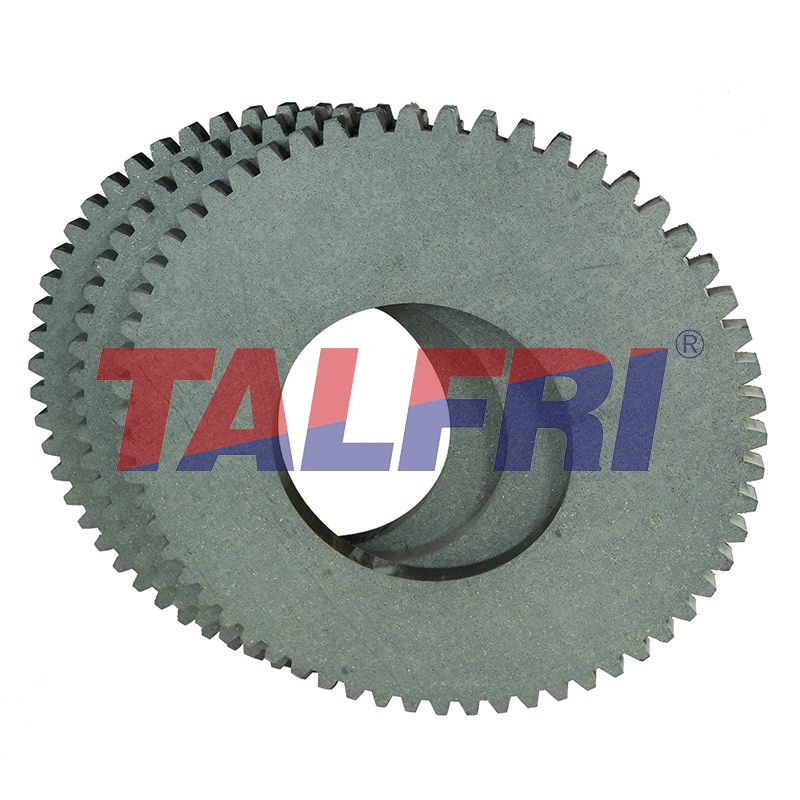
Regulatory landscapes heavily shape modern mechanical engineering decisions. You must navigate strict environmental mandates while maintaining peak operational performance. A major priority today involves addressing the aggressive phase-out of legacy materials. Many older machines originally relied on hazardous friction fibers.
Modern safety mandates require a complete transition to a non-asbestos friction plate. You cannot simply swap old parts for cheap, unverified alternatives. We evaluate aramid fibers, like Kevlar, alongside carbon-fiber mixtures. Engineers also test various metallic sintered blends carefully. These advanced custom materials must replicate legacy performance. Ideally, they should exceed the original coefficient of friction (CoF) levels. They must also provide superior heat resistance without creating any regulatory liabilities for your facility.
Next, we assess crossover applications to maximize durability and lifespan. Engineers often examine how compounds developed for heavy-duty industrial brake lining can adapt. We can often modify these robust brake mixtures for high-stress clutch applications. By tweaking the formula, we optimize the material for brute stopping power. We also ensure it handles smooth power transmission effectively.
Finally, meticulous resin and binder selection dictates long-term component survival. The phenolic resin matrix holds the friction fibers together under massive mechanical stress. You must match this matrix precisely to the kinetic energy requirements of your specific machinery. A weak or mismatched binder leads to premature shear failure. This usually happens during sudden shock loads or emergency stops.
Once you decide to customize, you need strictly metrics-driven evaluation criteria. We map specific material features to concrete, observable performance outcomes. You must define exact baseline requirements to ensure engineering success. Evaluating a customized industrial clutch friction plate requires analyzing four primary operational dimensions.
First, explicitly define the target Coefficient of Friction (CoF). You must specify exact requirements for both static (holding) friction and dynamic (engaging) friction. This precise balance prevents dangerous slippage under heavy loads. It also ensures smooth acceleration without stressing the drivetrain.
Second, establish clear and realistic wear rate predictions. You need to know the acceptable material thickness loss per 1,000 hours of operation. You must calculate this metric under peak load conditions, not just idle speeds. This crucial calculation directly informs your facility's preventative maintenance schedule.
Third, rigorously verify mating surface compatibility. The customized friction material must not destroy your existing opposing hardware. It should never cause excessive scoring on steel surfaces. It must also prevent thermal cracking on expensive cast iron reaction plates. Aggressive friction materials can sometimes eat through mating plates quickly.
Fourth, physically test the overall structural integrity of the newly molded part. You must evaluate the rotational burst strength of the material. Shear resistance of molded gear teeth becomes absolutely critical under severe shock loads. Spline engagements must hold firm during sudden torque spikes.
Evaluation Dimension | Primary Metric to Track | Expected Operational Outcome |
|---|---|---|
Target Coefficient of Friction | Static vs. Dynamic Ratio | Smooth mechanical engagement without drivetrain judder. |
Wear Rate Prediction | Thickness loss per 1,000 hrs | Predictable, safe preventative maintenance cycles. |
Mating Surface Compatibility | Opposing surface wear depth | Protects highly expensive cast iron reaction plates. |
Overall Structural Integrity | Shear resistance at gear splines | Prevents catastrophic gear teeth failure during shock. |
Custom manufacturing always introduces distinct logistical challenges. You must approach the supply chain with highly transparent assumptions. You also need realistic timelines for bespoke manufacturing. Building bespoke mechanical components requires significant upfront effort and testing.
You must acknowledge the stark reality of lead times. Minimum Order Quantities (MOQs) also play a massive role in custom procurement. Custom molds and bespoke material mixing require upfront time. They also require dedicated capital allocation. Tooling a brand new mold is never an overnight process. To mitigate these inherent delays, negotiate strategic safety stock agreements. Do this immediately post-validation. This strategy ensures you always have backup inventory resting on your shelves.
Furthermore, we must highlight the extreme danger of theoretical data. Extrapolated engineering data sheets are completely insufficient today. You cannot use them for Bottom of Funnel (BoF) procurement decisions. Do not trust a material compound just because a software simulation approved it. Software often misses sudden heat spikes in real-world environments.
Physical proof remains absolutely mandatory. You should always shortlist suppliers possessing robust in-house pressing and molding capabilities. Look exclusively for facilities operating certified testing equipment. Benches meeting strict UIC standards offer excellent validation. These precise tools allow engineers to physically validate inertia capacities. They also test extreme thermal limits thoroughly before authorizing full-scale production.
Finding the right industrial vendor involves much more than simply comparing price quotes. You need a rigorous qualification framework to identify truly capable manufacturing partners. A specialized friction manufacturer essentially acts as an extension of your own engineering team.
Start by closely evaluating their reverse engineering capabilities. Can the supplier accurately analyze a completely failed standard part? They should easily identify the precise formulation adjustment needed. If they cannot diagnose the root cause of the failure, they cannot engineer a lasting solution. They must understand why the original binder collapsed.
Next, critically assess their prototyping agility. You should ask if they offer pilot runs for new clients. Small-batch samples prove invaluable for field testing. Field testing a prototype allows you to verify performance in actual real-world conditions. You must secure these physical guarantees before locking in the final, highly expensive mold design.
Finally, demand strict traceability and relentless quality control. Every heavy industrial environment demands rigorous safety and compliance standards.
Ensure the manufacturing supplier provides comprehensive batch-level traceability for every order.
Verify their current ISO certifications covering specific mixing and molding processes.
Request detailed documentation for rigorous density testing on every single production run.
Confirm they perform routine hardness testing to guarantee batch-to-batch consistency.
These stringent quality control measures guarantee consistency across multiple reorders over the years.
Customizing a friction component represents a highly strategic investment. It directly boosts your long-term operational reliability. It is never just a superficial equipment upgrade. When you replace a failing standard component with an identically flawed stock part, you create a dangerous false economy. The repeated downtime quickly destroys any initial procurement savings.
To move forward effectively, follow these actionable next steps:
Gather your exact failure data immediately, including detailed wear patterns, peak operating temperatures, and machinery duty cycles.
Consult directly with a specialized friction material engineer to scope out a viable, heavy-duty custom solution based on your data.
Demand physical testing protocols from your chosen vendor, and never approve any large-scale production runs without seeing proof.
Establish robust post-validation safety stock agreements to protect your broader supply chain against future disruptions.
Taking these steps ensures your heavy machinery operates safely. It guarantees continuous production under the most demanding industrial conditions.
A: The entire process typically takes 6 to 12 weeks. This timeline depends heavily on the initial engineering complexity. The breakdown includes initial mold design, bespoke material formulation, and initial prototyping. Physical testing on certified benches takes additional time. Finally, the vendor moves to full-scale final production after your approval.
A: Initial prototype batches carry significant tooling and research premiums. You can expect costs to run 2x to 4x higher than standard components initially. However, unit costs drop significantly on subsequent reorders once the mold exists. You must frame this upfront investment around massive reductions in unplanned equipment downtime.
A: Yes, they absolutely can match legacy performance. However, success requires incredibly precise compound blending. Engineers utilize advanced aramid fibers and semi-metallic organic combinations. When properly engineered and cured, these modern formulas achieve identical coefficient of friction levels. They also deliver significantly superior heat dissipation compared to hazardous legacy parts.
A: This requirement varies drastically by manufacturer. Some agile facilities specialize entirely in low-volume, high-mix specialized mechanical parts. Other massive operations require much larger runs to justify batch-mixing the raw materials. We strongly advise buyers to ask about exact minimum order quantities during the very first initial inquiry.


